
'The Rising Sea' as a metaphor for progress in the environmental sciences?
About two ways to make progress towards solving scientific problems (imported from the world of mathematics)

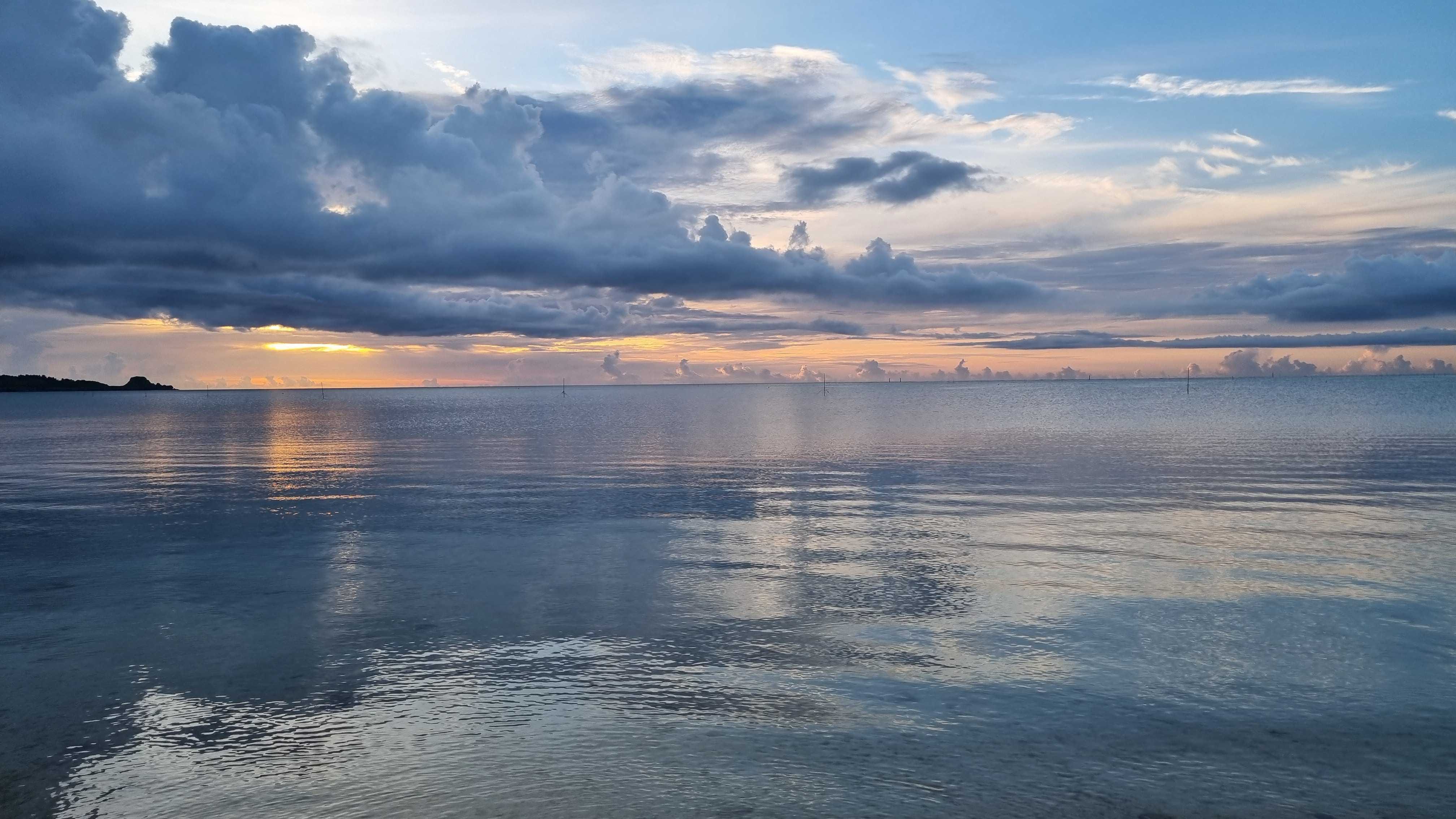
During my sabbatical in Okinawa, I frequently chatted with fellow visiting scientist Jon Brundan (University of Oregon), a mathematician working in category theory, about how math works. One of the most striking things I remember from these conversations, and the thought that keeps me occupied even now, is the idea of the “Rising Sea”. Alexander Grothendieck, a famous mathematician, used this metaphor to illustrate two different modes of approaching problems in mathematics (you can read the quote here). He likened the problem at hand with a nut to crack. One approach, the one with which we’re all familiar, is to simply work away at that nut with a tool until it’s cracked, this is the targeted approach, directly attacking the problem. The other approach, the more indirect one, is to soak the nut in water for a while until its shell is softened so that it can just be easily opened after a while. Grothendieck then goes on to say that the unknown areas and unsolved problems in mathematics are like pieces of land, surrounded by sea. And if the sea rises by means of general progress in theory, then all these land areas will be increasingly surrounded by the sea and eventually they will be inundated: the problems will be solved without targeted action, since the general ‘level’ of knowledge has just increased.
It’s a striking metaphor, I think. The sea rises very gradually, via advances in theory and by conceptual development. Over time, these developments will also be pertinent to problems that were initially not connected (some pieces of land somewhere in the landscape). The question is, will this also apply to other scientific endeavors outside of mathematics, which is perhaps more like ‘world-building’….?
Obviously, we still always need the hammer and chisel approach to cracking nuts. We have urgent problems to solve in environmental science. It would be hard to justify to do something other than directly attacking those hard problems with targeted research. But it is appealing to think about the ‘rising sea’ approach. How could it work?
Conceptual developments can connect areas that are seemingly disparate topics, this is done by finding similarities and analogies. This can have the effect that an advance in one area raises the sea — so to speak — in such a way that this advance also applies to a different area. Just a small example from my own work: inspired by the experimental approach pioneered by Tilman, the random sampling from a pool of species to create a gradient in species richness, we could use that exact same idea to work on multiple factors of global change. Two different topics were connected by means of an experimental design, basically a conceptual advance, that unlocked progress in a totally unrelated area of ecology. Importing and exchanging concepts and theories is thus clearly a way to a ‘rising sea’.
Or think of method development, this has been a key area of progress in biology (for example, CRISPR/Cas as a tool in molecular biology) but also in microbial ecology. Progress in molecular biology (such as high-throughput sequencing) has enabled tremendous systematic progress in microbial ecology, such that we can now describe microbial communities in the environment using these tools; something that wasn’t possible before. This wasn’t a targeted development to solve this problem, but it could be applied to it. Perhaps metagenomics is another case of sea level rise caused by method development: we can learn about functional properties without even culturing microbes from the environment and can obtain unprecedented levels of information this way. Maybe the next revolution is related to AI, something developed in a different field, but with promise and applicability in the environmental sciences. So, clearly tools with broad applicability contribute to the ‘rising sea’ in the environmental sciences.
I really don’t understand mathematics, and so I am not totally sure if this discussion is a good analogy to the situation in their particular field. But it does appear that the metaphor also applies to the environmental science (and maybe all sciences?). By making overall progress in multiple areas of broad applicability (concepts, theory, methods), the sea is rising, and that makes previously intractable problems totally doable.
If this is so, then that’s nice. But what does that mean for us in terms of doing science?
What I take this to mean for me is this: look for parallels among problems, fields, disciplines, approaches, concepts, so that I can contribute to the rising sea. Maybe in mathematics these connections are more obvious, but in the environmental sciences you need to work hard to realize these links, I think. The sea doesn’t just silently rise, you need to make it happen. Mostly, such new links connecting disparate fields are due to serendipity, you hear or read something more or less by chance that is then suddenly applicable. This in turn means you should stay open and curious; where can I make a connection?
The flip side is also interesting: can I work on issues that have the potential to lead to the rising sea? Can I work on problems that are likely to be more broadly applicable, to solve problems that are unrelated to mine? Maybe the multiple factor approach can be applied to many other contexts, for example (we’re already working on this). I am not sure how you really do this in a more premeditated way, but it’s fascinating to think about. I think some research developments lend themselves more immediately to this broad reach, think of bioinformatics pipelines or data base development (like NCBI where the rising sea of sequence information now allows you to interpret your own findings).
So what do you think? Does this make sense? What does the rising sea mean to you? How can contribute to it in other ways? Let me know your thoughts in the comments…
Thanks for sharing the insight of scientific advancement through a rising level of baseline knowledge. Over time, we are likely to learn that many seemingly disparate concepts are really the same thing, just given different names in different fields. Even MORE reason to nurture cross-disciplinary collaborations!
I loved this post, thank you! I’ve been keeping a document where I write down new research ideas, and some of them aren’t related to my PhD project. I’ve started exploring one that I’m particularly passionate about. It connects two disparate fields, just as you mentioned. I think it’s highly unlikely that I’ll be able to publish a paper on it, since it’s far from my research topic, but I also believe the effort won’t be wasted, as it may be a nice creativity exercise.